
Owner earns co-share; rest burns🌐 Public Note
SERP Eligibility & Market Structure Analysis
Fill out the fields below to get personalized AI-powered feedback.

SEO Geek
AI Analysis
Your personalized feedback will appear here after submission.
Ready for Analysis
Submit the form to receive your personalized AI-powered feedback and recommendations.
About this note
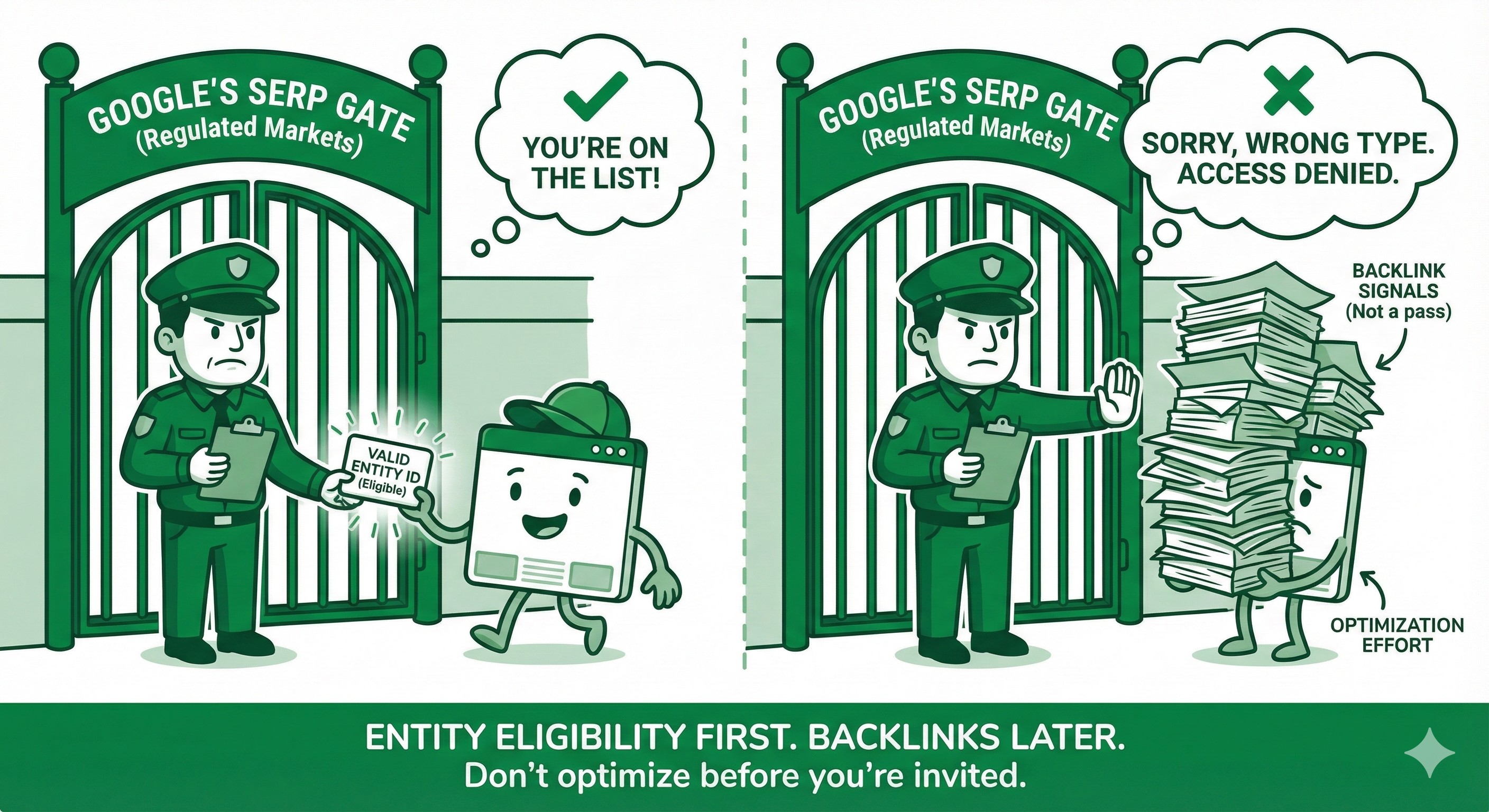
Decide whether ranking is possible before you waste effort
Most SEO tools start from an assumption that is rarely questioned: if you optimise hard enough, you can rank. They focus on backlink counts, keyword difficulty scores, content length, or technical benchmarks, all of which implicitly suggest that ranking is a matter of incremental improvement. What they often fail to answer is a far more fundamental question: whether your site is even considered a valid candidate for the SERP you are targeting.
This Note exists to answer that question first.
Google does not treat all SERPs equally. In many markets—especially those involving regulation, trust, or real-world risk—Google does not simply rank pages by relative strength. It first decides which types of entities are acceptable answers at all. Only after that decision does competition begin. If your site does not belong to the accepted entity class, no amount of optimisation will meaningfully change the outcome.
This SERP & Market Structure Diagnostic is designed to surface that reality clearly and early.
Rather than analysing pages in isolation, the Note examines the SERP as a system. It looks at who appears repeatedly, who never appears at all, how concentrated control is among a small number of entities, and whether Google is visibly testing new entrants or reinforcing incumbents. From those observable patterns, it determines whether the SERP is open, semi-locked, or structurally locked, and what that classification means for your domain in practical terms.
One of the first things users notice about this Note is what it deliberately does not include: backlink analysis. This is not an oversight. It is a conscious design decision rooted in how ranking systems actually work in gated SERPs. Backlinks are a differentiating signal among entities that are already eligible to compete. They do not determine eligibility itself. In markets where Google enforces entity legitimacy, jurisdictional alignment, or institutional trust, backlink strength does not grant access. It only affects ordering once access has already been granted.
By excluding backlinks, this Note forces the analysis to stay at the correct level of abstraction. It prevents the common but misleading conclusion that ranking difficulty is simply a matter of accumulating more authority signals. Instead, it focuses attention on the structural constraints that decide whether effort is viable in the first place. In many cases, the most valuable SEO decision is not how to optimise, but whether to proceed at all.
This makes the Note particularly valuable for senior SEO professionals, in-house growth leaders, consultants, and founders who are responsible for allocating time, budget, and organisational focus. Instead of encouraging incremental optimisation by default, it provides a disciplined way to say no, to defer, or to reposition before sunk costs accumulate.