
Owner earns co-share; rest burns🌐 Public Note
AI SEO Content Audit Tool 4.0
Get a professional-grade SEO audit with clear, actionable instructions to improve your content - powered by expert methodology and live SERP data.

SEO Geek
AI Analysis
View this run or your past responses.
Ready for Analysis
Submit the form to receive your personalized AI-powered feedback and recommendations.
About this note
AI SEO Audit Tool
Comprehensive SEO Content Audit
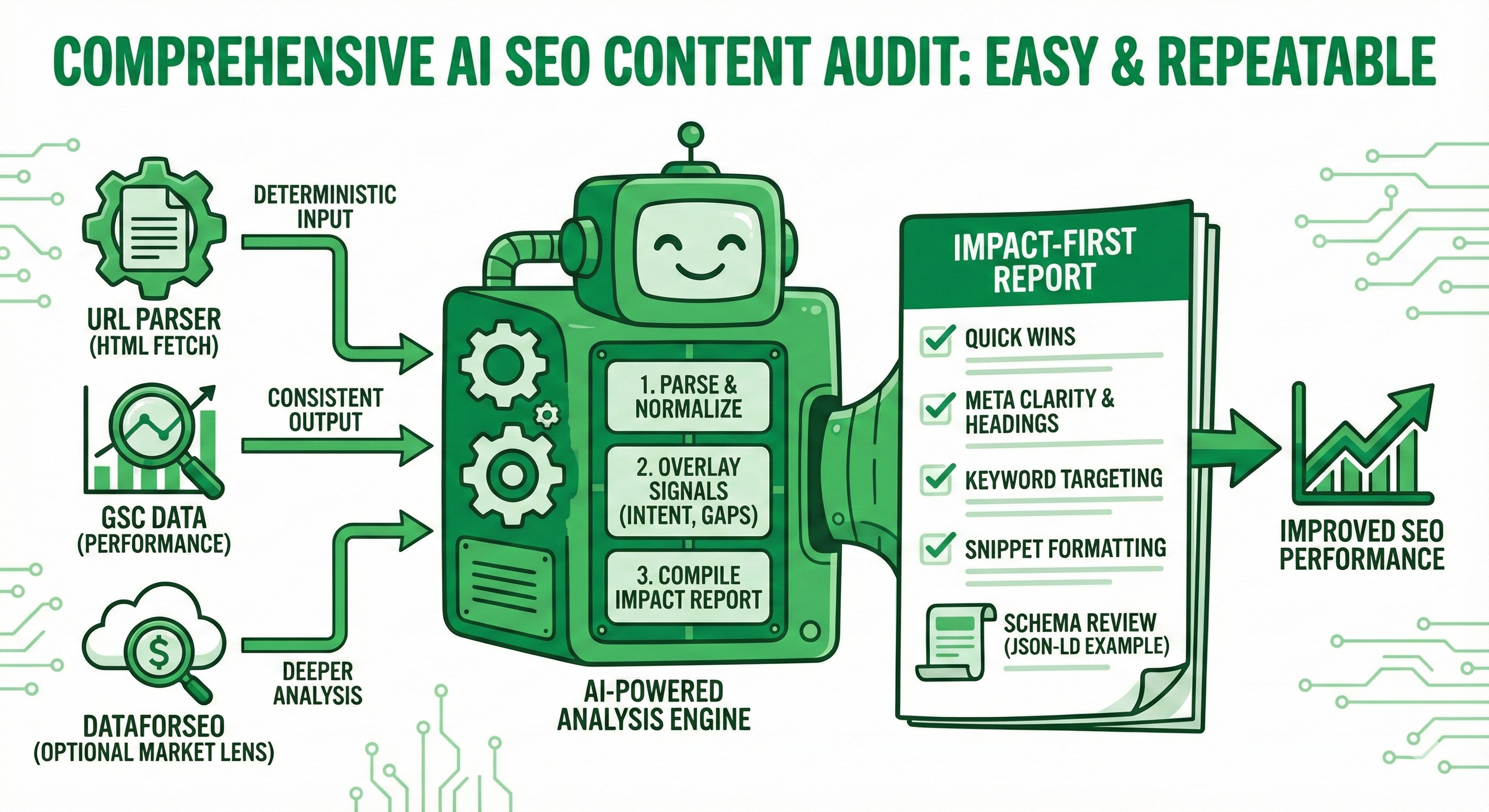
This is an AI-powered SEO content audit tool that analyzes a single page using two core inputs:
- A deterministic URL parser that fetches and parses the page HTML itself (not “asking the AI to crawl”), and
- Your Google Search Console (GSC) data.
The result is a consistent, repeatable audit that aligns on intent, E-E-A-T, freshness, keyword coverage, internal links, and schema.
Why the URL Parser Matters (Consistency > Guesswork)
Most audit prompts rely on the model to “crawl” a page or infer content from a summary. That’s noisy and inconsistent. Our URL parser directly retrieves the HTML, extracts meta tags, headings, body copy, links, and structured data, and then feeds those exact fields into the analysis.
Deterministic input → Deterministic output:
Same page, same result.
Optional: Market & SERP Lens with DataForSEO
For deeper analysis, this tool connects to DataForSEO for keyword, SERP, and competitor data. This adds a market-wide lens on top of your page-level and GSC insights:
- Keyword ideas and intents that your page doesn’t currently target
- SERP formats and feature types (snippets, PAA, local pack, etc.) that shape how you should structure content
- Competitor benchmarks for depth, coverage, and authority
Combined with the URL parser and GSC, this gives you a full picture: how the page is built, how it currently performs, and where the wider market expects it to go.
How It Works
First, the tool parses the HTML and normalizes all key fields, including title, description, canonical, H1–H3, internal links, and JSON-LD or Microdata. Next, it overlays GSC signals such as clicks, impressions, CTR, and positions to reveal intent gaps, cannibalization, and CTR opportunities.
Finally, it compiles an impact-first report that opens with Quick Wins and proceeds through meta clarity, opening paragraph alignment, heading structure, keyword targeting, snippet formatting, media accessibility, and a deep schema review with a ready-to-use JSON-LD example.
Sample Keywords Recommendation
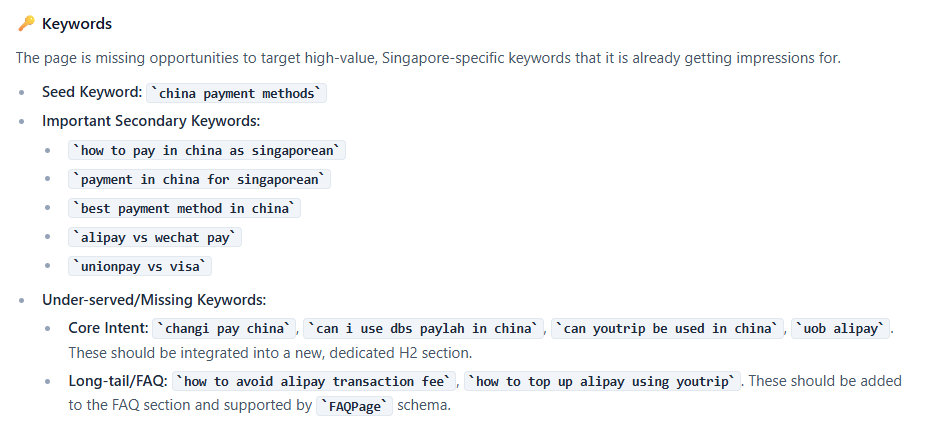
Sample Keywords Recommendation by AI Tool
Sample Tech Schema Recommendation
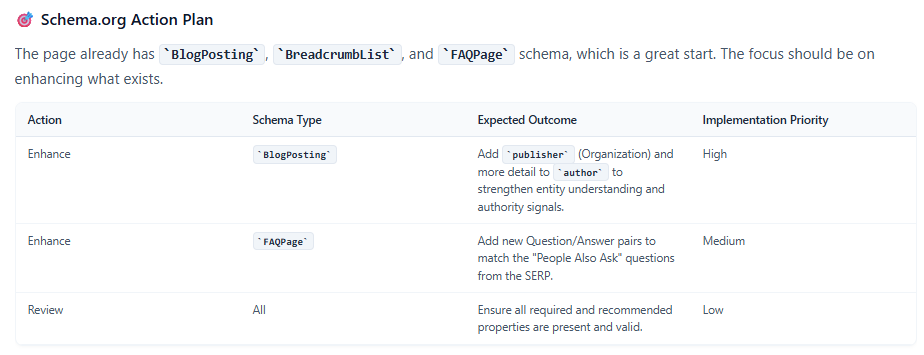
Sample Tech Schema Recommendation by AI Tool
What You’ll Get
You receive a concise but opinionated write-up that highlights the highest-leverage fixes, explains why they matter, and shows exactly where to apply them. Titles and descriptions are rewritten for intent and CTR, openings are tightened to reinforce the seed keyword, internal links are mapped to conversion paths, and structured data is validated and enhanced for rich result eligibility. Every recommendation is scoped for fast handoff to writers and developers.
When DataForSEO is used, you also get clear guidance on which additional queries, formats, and SERP features to target so you’re not just fixing a page in isolation, but repositioning it in the real competitive landscape.
Who It’s For
This Note is built for SEO managers, content leads, editors, and growth teams who need consistent, repeatable audits that won’t change on the same input. If your goal is to lift CTR, reduce cannibalization, and earn richer SERP treatments with minimal back-and-forth, this tool gives you a dependable blueprint you can act on immediately.